

Traditionally, the marketing journey for smaller law firms begins with word of mouth referrals, local reputation, personal connections or an ad space in a local newspaper.
Traditional marketing can reach targeted audiences through respected publications like The Straits Times. Older demographics and senior decision makers may still value printed media such as magazines and newspapers that they can touch and see.

However, there are considerable cost considerations for smaller law firms engaging traditional marketing. First, you have to hire a video production agency starting at $2500 to shoot your commercial, and then you have to purchase a $6088 spot (Mediacorp rates as of Feb 2025). Your minimal upfront cost is more than $8500 before a single lead is generated.
Why a Digital Marketing Strategy for Law Firms
Unlike traditional marketing, digital marketing is measurable. This means you can identify what is working, do more of it and stop wasting time on campaigns that don’t work. There are many variables you can test and control with digital marketing.
You can A/B test marketing headlines on your landing page. You can also adjust the budget of your advertisements. You can make changes instantaneously. You can’t do this with mainstream marketing channels such as television or radio. There’s also generally a much lower cost in producing a social media ad compared to a TV ad.
Meta platforms are the most popular social media platforms in Singapore. There are approximately 3.7 million Facebook users in Singapore, accounting for 63% of the population, and 3.15 million Instagram users. Google owns more than 95% of the search engine market share in Singapore, and also owns YouTube, where Singaporeans of all ages come for entertainment, education, shopping and more..
Positioning Strategy for Law Firms in Singapore
Lawyers, law firms and legal services are perceived to be elite, prestigious and expensive. Legal services in Singapore are governed by the Legal Profession Act, which does not prohibit advertising but restrains the style of messaging. Legal services cannot compare or criticise other firms, imply that competitors overcharge or provide inferior service, or publish anything that diminishes public confidence in the legal profession.
Hence, legal content and advertising is naturally more educative in nature. However, in my experience, many Singaporean lawyers resist publishing legal content on their websites. It can be misconstrued as advice, or frankly, they make money from giving out advice. So why give it out for free?
The big four/ big five firms in Singapore’s legal industry leans on authority and brand. However, smaller firms can take a different positioning: you can differentiate through education and relatability.
Today, there are many law firms out there driving clicks to their law firm websites through Google ads. Yet, it is no longer enough to get clicks from users searching for terms like “civil case Singapore” or “filing a civil suit.” Consumers need to be further educated in a relatable manner after they click through the ad onto your website. That’s why content marketing with a tinge of positioning can make the difference.
Niching Down or Choosing to Focus On One Main Practice Area
From a cold audience standpoint (meaning you are marketing to people who don’t already know, like or trust you) you can’t be everything to everyone. The moment you try to market “we are a full service law firm that handles disputes, divorces, criminal matters, corporate work and probate,” your message becomes diluted and weak. The generic ad you run loses impact.
Some lawyers that run their own smaller practices tell me they are full service firms, and that they do everything. That may be true, but their practice probably leans towards one or two practice areas that clients keep coming back to them for. If you’re marketing to cold audiences, the market has to perceive you as a specialist.
Content Marketing for Law Firms
Yet, two of the laws of persuasion is reciprocity and authority.
Once you identify your customer’s fears, concerns and frustrations regarding a certain practice area, you can craft legal content that is both unique to your service and educative in nature. Then distribute this across your ads and landing pages. In this live Facebook ad for a civil litigation law firm in Singapore, we educated the audience on the benefits of legal recourse as opposed to private debt collection.

For our client, a civil litigation law firm, we positioned legal recourse against alternative methods like private debt collection for their debt recovery campaign. We explained that legal recourse carries real weight. Going through the courts establishes formal and documented obligations for the claimant’s opponent, meaning there are real consequences if the debtor does not comply.
We also explained the three stage process of debt recovery through the legal system: sending a letter of demand first, obtaining judgment second, and then having enforcement options available within a 12 year window. Instead of outright telling people that they should engage legal services now and sue to get their money back, we combined consumer psychology and legal knowledge. You don’t outrightly marketing your service. You ‘sell’ the method.
The key principle is to address common legal questions in plain language. Use FAQs, videos or infographics to turn legal jargon into something a layman can actually understand.
Google (Ads) SEM Strategy for Law Firms
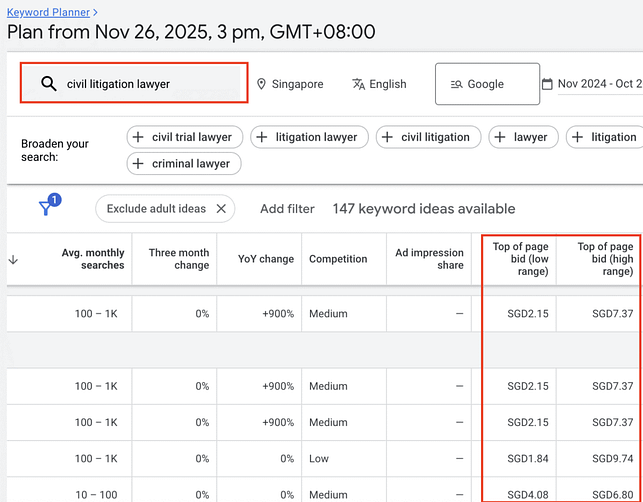
From a search engine marketing data standpoint, your cost per click for targeted keywords such as “civil litigation lawyer” can go up to $9.74. Imagine paying almost $10 for a click. A Google Ads strategy focuses on bottom-of-the-funnel keywords where people are ready to hire. If done right, you will be able to achieve a return on investment.
When you search for “debt recovery lawyer” the top results are packed with sponsored ads from competing firms. Everyone’s bidding on the same keywords.
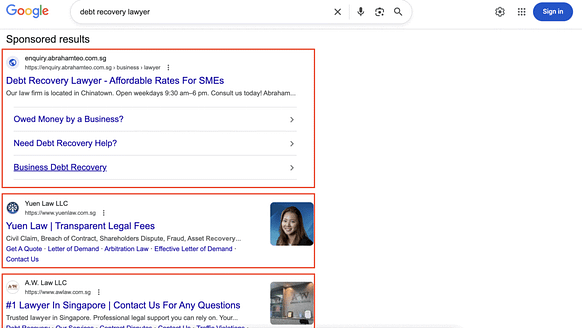
Google owns more than 95% market share in the Singapore search engine market. Every time you type in a commercial keyword for the legal industry, you are inundated with Google ads with not-so-good landing pages. It is extremely competitive and expensive.
From a search engine marketing perspective, you’ll want to drive specific traffic straight to the intended key practice area. Traffic from employment law keywords should be sent to the employment law practice area page. Traffic from family law keywords to the family law practice area page and so on and so forth. You’re risking drop-off traffic when you send everyone to your homepage, and from Google’s standpoint, users only want to land on pages that are contextually relevant to the ad.
Meta Advertising Strategy for Law Firms
In my professional judgment, Meta advertising is where law firms currently have an advantage. That is because most law firms haven’t figured Meta Ads out yet. The competition is lesser, there is more creative leeway and hence more opportunities.
Through paid advertising on Meta platforms, you’re able to target, slice, and dice demographics according to age, race, gender, likes, and dislikes. This is extremely powerful.
Pushing content on Meta platforms is not a new concept. SingaporeLegalAdvice.com does a great job on their Instagram page, posting organic content and building a sizeable audience.
For our civil litigation law firm’s campaign, we sent all of our debt recovery campaign’s traffic to the debt recovery page, and none to the home page. That’s how we got pretty good conversion rates at a good cost by driving traffic to a specific key practice area page.
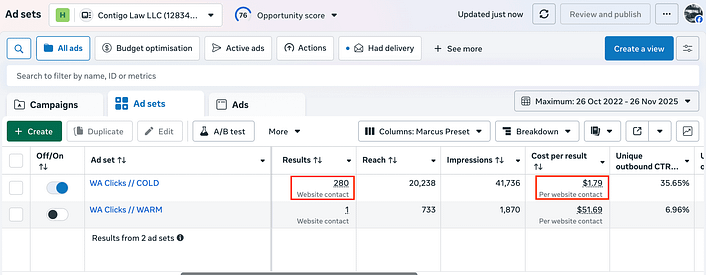
From the image below, you can see that we generated 280 WhatsApp clicks to enquiries for $1.79 per WhatsApp click to enquiry for the entire campaign. From those clicks, we generated WhatsApp conversations that led to consults and signed cases.
Kelvin Ong from Contigo Law LLC has also provided a testimonial that states that he signed clients through our process.
For lawyers in Singapore, there is clear search competition and strong demand in pay-per-click advertising methods. However because almost every law firm is buying Google ad space, the Meta advertising present a true blue ocean opportunity. When others zig, you zag. Start with Meta platforms while everyone else piles onto Google.
Through proper analytics, tracking and strategic positioning, and you are on your way to creating a highly scalable client acquisition system.
SEO Strategy for Law Firms
SEO is preferred by many lawyers I speak to. That’s because the legal industry traditionally has many rules constraining advertising, so they much prefer an organic approach.
The principles of SEO are similar to those of content marketing for law firms, as mentioned earlier in this article. Your practice area pages should be structured around keywords that your ideal clients are already searching for, matching their search queries to the content of your pages. The same content marketing principles apply: ease up on the complex legal terminology and create customer oriented content that speaks directly to concerns and pain points.
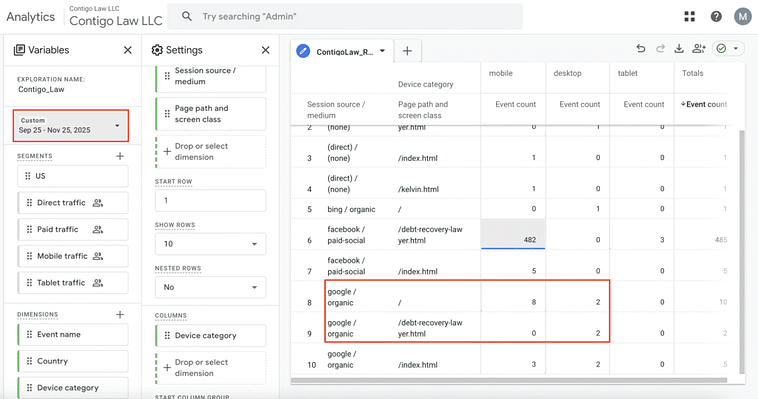
Since I was SEO trained, I naturally built our law firm client’s practice area landing page with SEO principles in mind. The page ranked on Google.com.sg Page One for “debt recovery lawyer Singapore,” a keyword with high commercial intent for businesses and individuals looking for debt recovery legal services.
Our team also managed to drive some free potential leads through organic SEO through his debt recovery page.
Google Analytics and Performance Marketing Strategy for Law Firms
Some time ago, I spoke to a lawyer who specializes in family law, and he’s spending around $3000 to $5000 a month on Google advertising. I asked him if he’s tracking his ads from lead to client sign-up intake. He said no.
Ideally, you want to track every lead from ad to client onboarding. Which advertising channel did they come from? How did they get in touch with you, through WhatsApp or a form? How qualified are they as a lead? Did they become a client? What were their objections or concerns during your consultation calls?
For performance marketing, we’ll help you install digital analytics setups: namely Google Analytics, Google Tag Manager and a Google Spreadsheet that updates whenever someone fills out a form or books a call with you on your site.
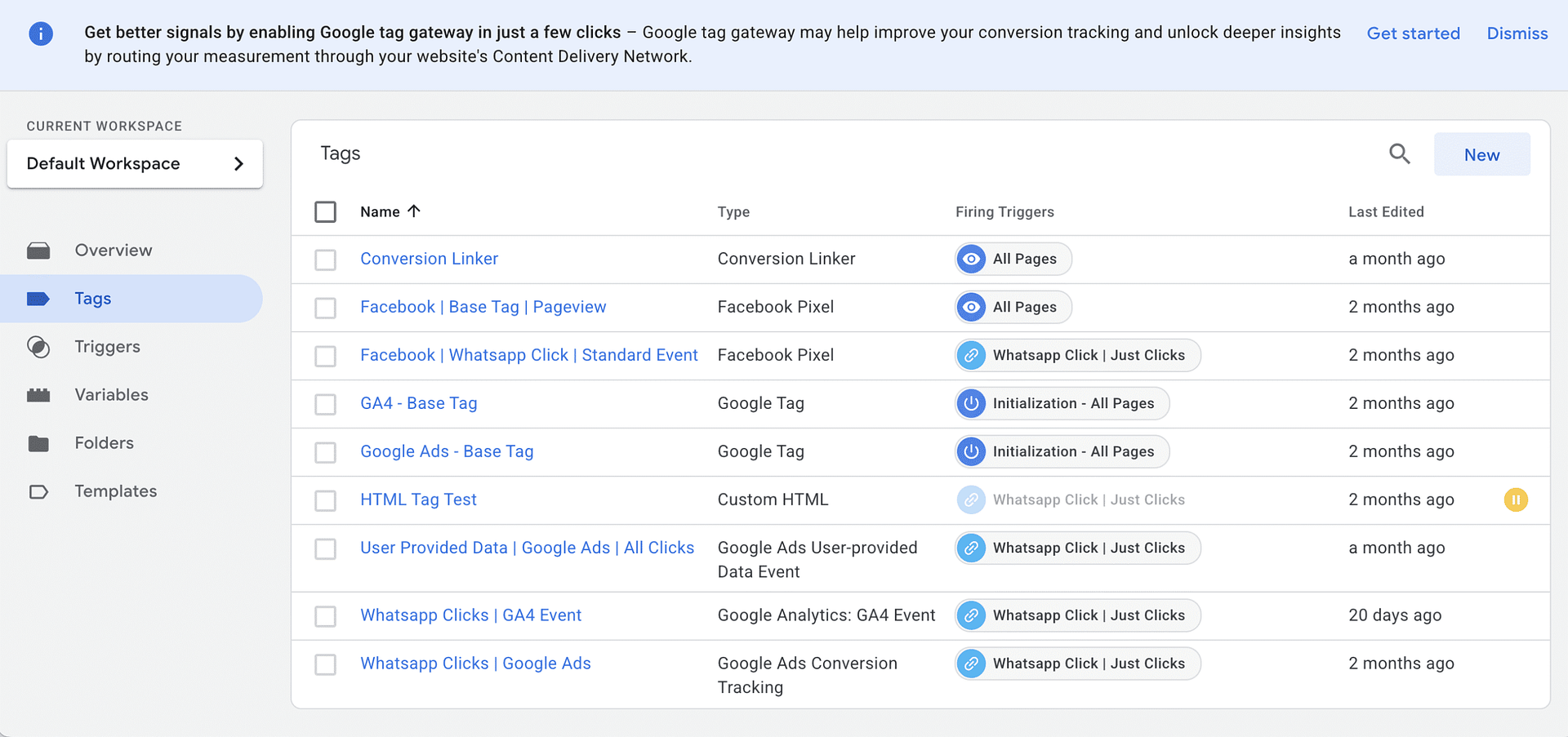
In performance marketing, you want to know exactly where every dollar spent on ads turns into revenue. Track which specific channel your leads are coming from (organic, direct, referral, paid social) and which practice area is generating the highest revenue for your firm. This way you can eventually get to the point of spending $1 and generating $2 or more. That’s the entire basis of our agency: we help you scale through a data driven approach.
Customer Intake System
Smaller law firms may not have any intake or lead management system. In my experience, the main lawyer is doing all the consulting, sales and legal work with no customer intake tracking.
Having an intake system not only helps with revenue tracking, but also allows you to regularly collect market feedback by learning about the objections raised in client consultations. It also helps with defining client characteristics such as age, location, income level, interests and buying behaviour. The messaging that resonates with a tech-savvy millennial founder needing IP protection is going to differ significantly from what appeals to a retired professional seeking estate planning advice.
This allows you to continuously refine this feedback loop between your market and your ideal customer profiles.
Digital Marketing Challenges in the Legal Industry: Legal Profession Act
Legal Profession Act
Lawyers I speak to here in Singapore are worried that paid digital marketing such as Google advertising cheapens their law firm brand. They are worried that Meta advertising isn’t the right channel to grow their law firm, or that they’ll flout the legal profession publicity rules.
I am not asking you to contravene the laws and guidelines, and I am fully aware of the legal industry’s compliance requirements. You can refer to the Law Society Singapore advertising ethical guidelines for the legal industry in Singapore.
There are no legal limitations on using Meta platforms to advertise your practice. It’s how your advertising agency goes about it. Yes, a good marketing agency will be sensitive to the legal profession’s rules and how to go about advertising your legal services.
Brand Concerns
Some lawyers I speak to in Singapore are worried that paid digital marketing such as Google advertising cheapens their law firm brand. They are worried that Meta advertising isn’t the right channel to grow their practice, or that they will flout the legal profession publicity rules. Yet some of these concerns are unfounded. Even statutory boards in Singapore use sponsored Meta advertising to drive their messages out.

If you are still overly worried about cheapening your legal practice brand, or are overly concerned about the regulations of the Legal Profession Act, then perhaps it is better to stick to traditional methods such as newspaper ad buys and a referral system.
Conclusion
Whether it is a well-targeted Meta campaign, a Google Ads search campaign built around high-intent keywords, or an SEO-driven practice area page that ranks on page one, there are clear digital marketing opportunities for legal services. You do not have to compromise your brand or your professional obligations to market effectively.
You simply need the right agency partner that understands the nuances of the legal industry.
