
Today, digital marketing channels such as SEO, SEM, and Meta advertising are highly effective for driving patients to your clinic. However, as a doctor, dentist, psychologist, physiotherapist, chiropractor, or healthcare practitioner, you spent years in medical school to help patients, not to write Google Ads copy, troubleshoot WordPress installations, conduct SEO keyword research, or manage a CRM pipeline, let alone master digital marketing to fill your clinic’s schedule.
Why Digital Marketing for Healthcare
When patients feel pain, they Google “dentist near me” or “GP near me”, research medical options on YouTube and compare clinics before booking a consultation. If you’re great at what you do but invisible online, you’ll be invisible to patients that actually need your help.
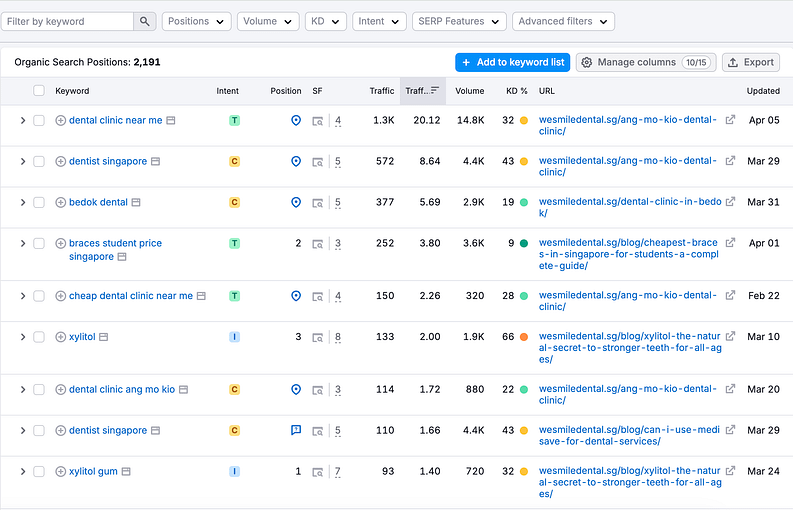
Here’s Semrush’s data on keyword search in Singapore for dentistry:
Singapore’s IMDA Digital Society Report found that 99% of resident households are connected to the internet, and 97% of adults own a smartphone. This means that your next patient is almost certainly searching for you right now, on the device in their pocket. Over 62% of all web traffic in Singapore already comes from mobile devices, and healthcare is no exception. Research shows that close to 8 in 10 patients conduct online research before choosing a provider. They compare credentials, read reviews and assessing clinic websites before they ever pick up the phone.
That is where we, as a healthcare marketing digital agency, come in.
Healthcare Digital Marketing and the Patient’s Customer Journey
My own customer journey for healthcare services taught me as a marketer: an educated and empowered patient is a sold patient.
I found the experience of being referred from GP doctors in our polyclinic system to long wait times at the National Dental Centre wearisome. It’s simply a feature of the public healthcare system in Singapore because they are swamped with cases.
Second, as patients, when in pain, it’s natural to obsessively search for solutions and options. That’s because we’re looking to ease literal pain! The general public, like me, is far from medically trained, but as a consumer I also wanted to be an educated patient to find out what the hell was going on with my teeth.
If you as a medical practitioner are great at what you do, then there’s no reason for you or your content to not show up when a user is going through this process!
That is where our healthcare marketing services come in.
Positioning and Pricing for Healthcare Services
I shall retrace my own patient consumer journey for a root canal treatment, and relay how I eventually decided to spend a premium on a particular clinic.
Positioning Strategy: Being a Category of One
I searched high and low online for a dental clinic that best suited my needs. I was not persuaded by the usual dental procedures after multiple fillings done year after year. I also had experienced slight bill shocks in prior visits. I went in complaining of pain on one tooth but left with 8-10 fillings on multiple tooths. I was also doubtful of the filling process. How does the filling process work and does it take away natural tooth structure?
I started researching alternatives. I typed “holistic dentistry Singapore” into Google.Com.Sg. I went through Google’s results and found that there are roughly three providers that purport to practice holistic dentistry in Singapore.
I eventually got persuaded by one particular dental clinic. Not to mention, they did a great job at marketing themselves.
They had:
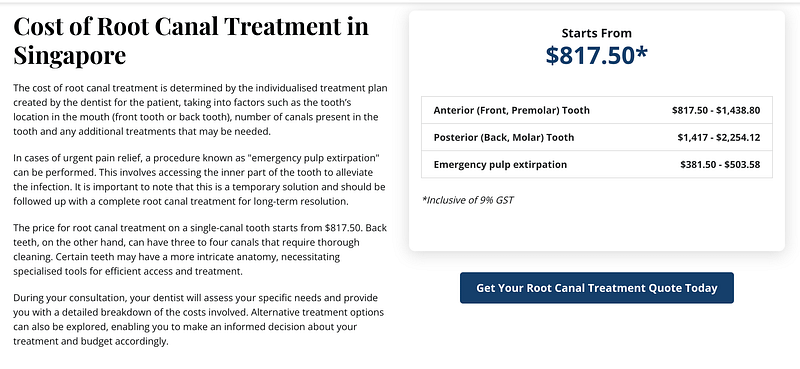
- Transparent fees,
- Clear Dentist Profiles
- Specialist dentists doing YouTube explainer videos on their website
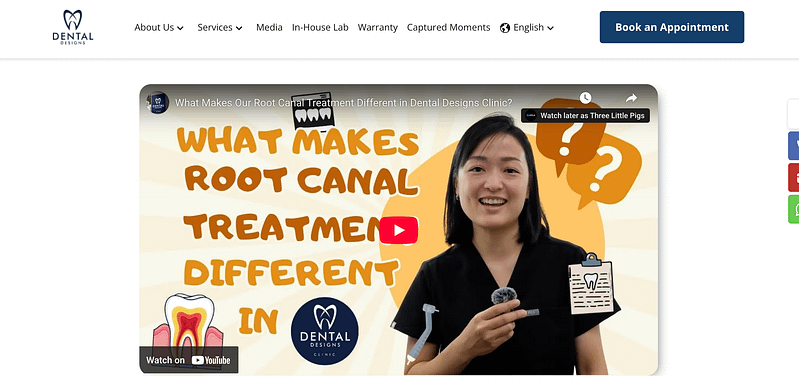
I remember telling my dentist that I was impressed by their marketing and online user experience. Their Google reviews were also quite strong. That is why I cancelled my root canal treatment at my neighbourhood clinic and switched to this more upscale provider.
Pricing Strategy as a Clinic
Neighbourhood dental clinics compete on price, accessibility and affordability (nothing wrong with that), while premium dental clinics differentiate themselves through USPs.
I initially booked a consultation at a neighbourhood dental centre. The visit resulted in two painful fillings without anaesthesia and a tooth cleaning.
I opted for the more upscale clinic in spite of a root canal treatment costing four to five times more. That is because as a customer, I was willing to pay a premium for its positioning in the marketplace. The clinic had clearly defined its unique selling proposition through its holistic approach to dentistry and root canal treatments, and I was sold.
Positioning Strategy: Articulating Your Clinic’s USP
There are only two or three other dentists in Singapore who cite the use of holistic dentistry. Through their focus on holistic dental treatments, they positioned themselves in a category of one.
This clinic explained that they use dental microscope technology to avoid removing too much healthy, natural tooth structure. That was music to my ears, as I had more than enough fillings done over the years.
In my previous visits to the dentist, I never really knew what was happening in my mouth. However, after some self-education and watching a few educational YouTube videos, I learned that traditional fillings involve drilling away decay and healthy tooth structure before filling the cavity with metal. I wanted to avoid a situation where good teeth were unnecessarily removed just to place fillings. This clinic also mentioned using biocompatible materials and ceramics instead. That was a clear and compelling selling point for me.
They also clearly illustrated their unique approach to holistic dentistry and root canal treatment. It was shown clearly WHY they were different from every other dental clinic.
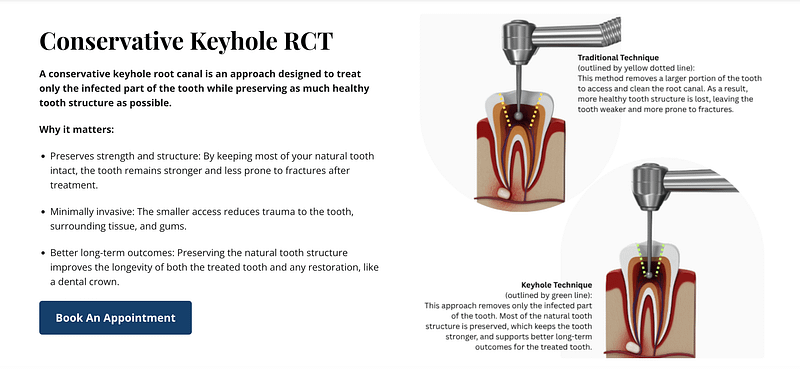
The other clinics’ landing pages did not clearly explain how they differed from conventional practices, simply stating that they offered “holistic dentistry.” Their fees also lacked transparency.
The empowered patient is the best customer after all!
Key Digital Marketing Channels for Healthcare
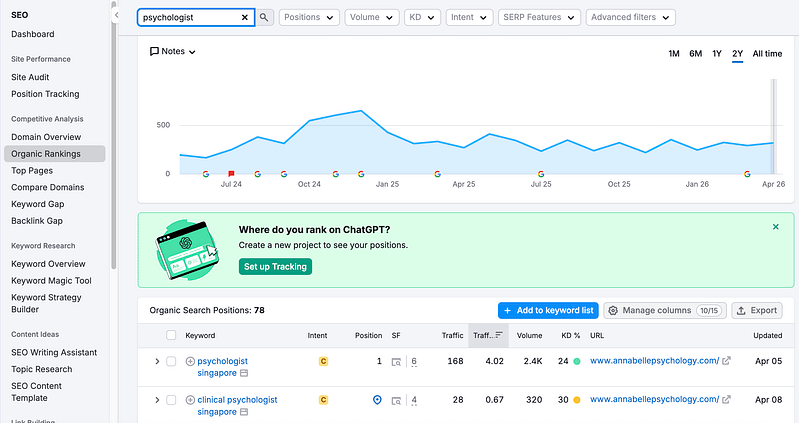
SEO, SEM and Meta advertising are the go to digital marketing channels for healthcare services. There is no lack of search demand for dental services in Singapore, and it even goes down to the local level such as “dental clinic in Bedok” or “dental clinic in Ang Mo Kio” as demonstrated.
Google Ads (SEM) for Healthcare: Get Immediate Patients
Someone typing “root canal treatment Singapore” or “psychologist Singapore” has high intent to book an appointment. Google Ads (SEM) puts your clinic at the top of relevant search results, ahead of organic listings. Thus, bidding on these search queries (keywords) can drive immediate enquiries for your clinic.
Google’s algorithm weighs your ad bid against factors such as ad relevance, expected click through rate, and the quality of your landing page.
Our goal with our healthcare marketing services is to help you drive patients from Google to a clear, well structured page that positions your clinic’s USP while explaining and educating patients about a medical procedure. This differentiates your clinic and also empowers your potential patients to make an informed medical decision.
Meta Advertising & Social Media Advertising for Healthcare Services
Unlike Google Ads, Meta advertising on Facebook and Instagram is a push marketing channel. You are not waiting for a patient to search for you.
This makes it particularly well suited for elective and aesthetic medical services: skin treatments, dental veneers and hair restoration are all categories where patients may not be actively searching. Yes, a well produced reel of a dermatologist explaining a procedure can do the heavy lifting that a text based Google Ad simply cannot. Meta can also be used as a retargeting channel for traffic driven through Google Ads.
Secondly, the cost per click on Meta is generally lower, there is more digital real estate and visual creative leeway, making it a highly strategic entry point for clinics.
Email Marketing for Healthcare Services
The dental clinic I visited offered a pop up featuring a free PDF that educated patients on root canal treatments.
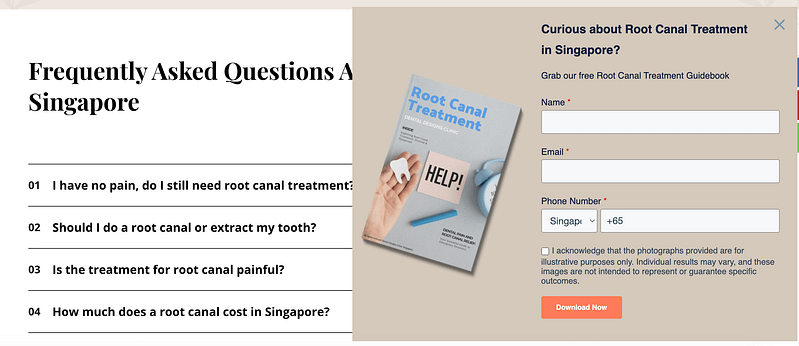
I downloaded the PDF and found it filled with illustrative graphics explaining the procedure. I also watched an accompanying explainer video and appreciated their use of ceramic fillings instead of metal ones. In my view, email marketing is not strictly necessary, but it serves as a valuable bonus strategy for your clinic.
Medical SEO for Long Term Patient Acquisition
Medical SEO services are highly sought after in Singapore’s healthcare digital marketing industry. You have likely heard about AI ad nauseam, yet producing SEO optimized static content for your practice remains equally important for both marketing and being picked up by LLMs.
I recently searched for “holistic dentistry Singapore” to find localized results. I discovered specific dental clinics offering these services through standard search engines, not through Claude or ChatGPT. This experience reinforced the value of static, search engine optimized content.
LLMs such as Claude and ChatGPT parse data, learn from it, and generate output, but they can also hallucinate. If you are a patient seeking medical advice from an LLM, you will likely cross reference cited outputs with source material. This is why getting your content indexed by Google plays an important role.
As an SEO specialist, I ensure the landing pages our agency crafts are always aligned with searcher intent. This approach helps achieve higher rankings in organic search and improves quality scores when bidding on SEM results.
Content Marketing for Healthcare
I started off this root canal journey by being referred by my father to a neighbourhood clinic. He said it is ‘cheap’. I initially thought all dental clinics are made equal. I happily went for my first session.
It ended with two metallic tasting fillings, and I left begrudgingly because I had been doing fillings at the rate of at least once year now for the last decade. I always wondered what the hell was going on and if my teeth were made to be decayed so easily.
That was when I looked for alternatives, typed into Claude, and it returned the concept of holistic dentistry to me.
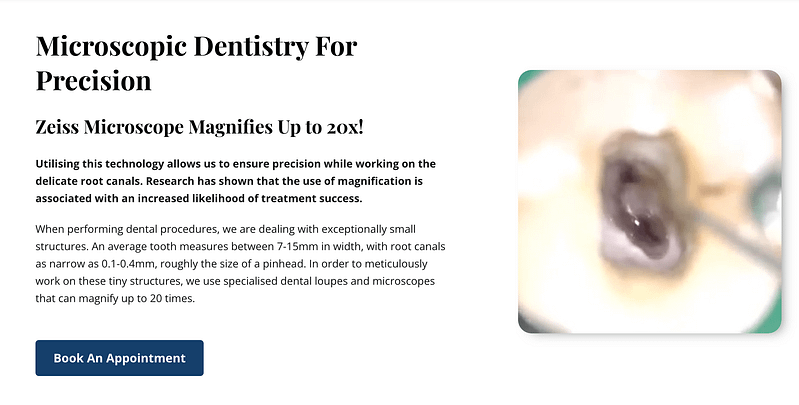
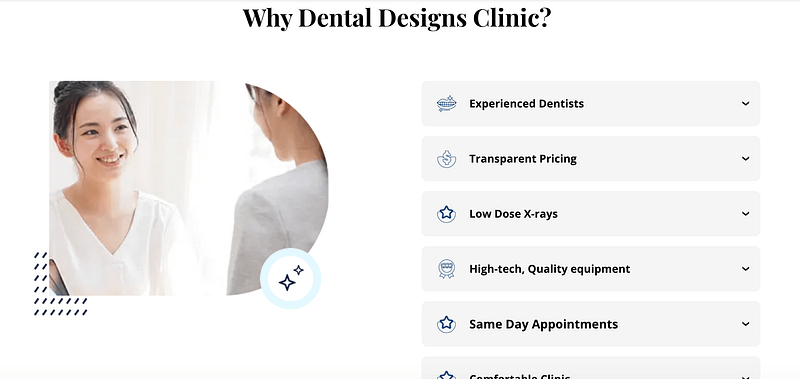
The dental clinic marketed each and every dentist and their staff like a personal brand. This allayed my fears of walking into a sanitized environment (like many dental clinics) filled with serious-looking dentists that only wanted to get business done.
Local SEO and Google Business Profile
Local SEO is essential for healthcare services in Singapore. It helps you appear when patients search “dentist near me” or “dentist Tampines”.
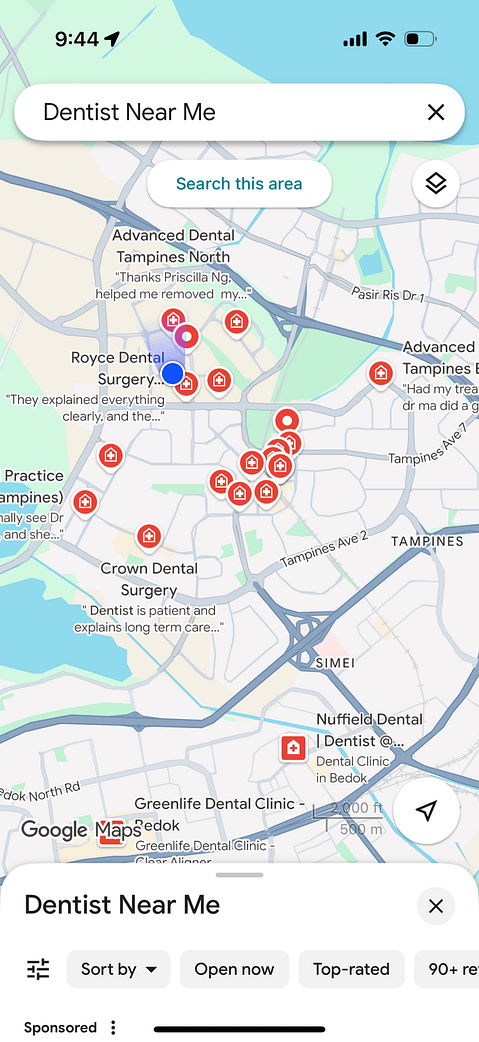
Unlike traditional SEO, local search is easier to optimize. You don’t need a ton of backlinks, and your clinic can still show up above AI answers and regular search results.
Start with a free Google My Business profile so you appear on Google Maps and the Maps Pack, which is where nearby patients usually look first. From there, include proximity based keywords such as “Dental Clinic Tampines”. On your website, include specific location based pages for each service and location. Local SEO can give small clinics a real shot at outranking big hospital groups for localized searches, all because of proximity.
You can then expand and list your healthcare services with keywords with search demand like “Root Canal Treatment” or “Teeth Whitening”.
How is Performance Marketing Related to Digital Marketing in Healthcare?
Performance marketing for healthcare is a data-driven approach to patient acquisition where every marketing dollar is tracked, measured, and optimized against specific high-value outcomes such as booked consultations, treatment acceptances, or lifetime patient value rather than vanity metrics like clicks or impressions.
You identify exactly which channels (Google Ads, Meta, Local SEO) bring in qualified patients, understand their specific objections and needs through intake data, and continuously refine your messaging and budget allocation to maximize return on ad spend (ROAS).
It transforms marketing from a speculative expense into a predictable, scalable revenue engine, ensuring that your clinic attracts not just more patients, but the right patients who are educated, empowered, and ready to commit to care.
Unique Challenges in Healthcare Marketing
Regulations and Compliance
Under the Healthcare Services (Advertisement) Regulations 2021, clinics cannot publish public testimonials, before‑and‑after photos, or superlatives like “best” or “most advanced”. Content must be factual, non‑comparative, and free from undue solicitation.
This is why healthcare marketing naturally defaults to being educational, while remaining as patient-friendly as possible. My goal as a healthcare marketer is to work alongside doctors and specialists, translating technical medical jargon into clear, empathetic language that patients can actually understand.
Insurance Claims Knowledge
Singaporeans are concerned about insurance when it comes to healthcare services. They often feel confused about how coverage applies across different practice areas: day surgery, inpatient care, specialist consultations, and more. This uncertainty can delay care or lead to unexpected out-of-pocket costs.
Clear content that explains whether your practice accepts insurance claims and outlines pre-authorisation steps builds trust. When patients understand what their insurance covers before they walk through the door, they feel more confident, ask better questions, and engage more meaningfully with their care journey.
Educating the Public on Singapore Healthcare Processes
Private clinics can educate patients on the benefits of going private, such as widely advertised same-day crowns. My own dental emergency highlighted why this clarity matters.
When my premolar chipped off and caused throbbing pain, I navigated the public system: a polyclinic GP deferred to specialists, and a public dental clinic only took X-rays, scheduled a cleaning, and told me to wait for a National Dental Centre appointment. Many patients don’t realize that public dental care requires a separate consultation before treatment, with the two visits often scheduled on different days.
Between the referrals and delays, I scrambled to understand CHAS subsidies, Medisave usage and government healthcare rates. Turning to Google and Claude for answers, I found a surprising gap. It was private clinic websites that better explained payment options and subsidy eligibility.
Final Thoughts
Going through my root canal journey as a patient opened my eyes to the marketing realities of healthcare services in Singapore. I used to rely mostly on the public healthcare system, but when I needed something timely, transparent, and tailored, I relied on Google, LLMs and Youtube for my decision making.
If you are a medical practitioner with expertise to offer, your skills deserve to be found. The goal of digital marketing for healthcare is not to turn you into a copywriter or a data analyst. It is about ensuring that when someone in pain searches for help, your clinic appears as a credible and accessible solution, ready to provide the care they need.
Performance marketing adds data driven rigor to this mission by tracking what works, learning from patient consultations, and reinvesting in the channels and messages that attract qualified patients. This approach helps your practice grow sustainably while you focus on delivering exceptional care.
