

Semantic SEO is a big word and can be a confusing concept. Semantic SEO as a topic was popularised by Koray Tuğberk GÜBÜR. I have to admit, in the beginning it was impossible to understand him. He has quite a technical prose when it comes to explaining.
In my limited understanding, I roughly guessed that you have to create topical clusters, related topics to each other, then to one main theme. This way, the search engine deems you an authority because your content is all “semantically” related to each other.
However, Koray insists that his description and explanation of semantic SEO largely differs from traditional topical clusters, and even traditional explanations of topical authority.
Personally, I feel the best way is to test it, as I will be demonstrating in this article. Now before that, let us figure out what the heck semantic SEO actually is.
What is Semantic SEO
The central idea: search engines no longer look at keywords, or even queries, to match them to content outputted in the search results.
They understand “topics” and deem them to be connected to each other through a web of relationships. This gives rise to the concept of a topical map. The theory is this: by publishing pages and blog articles in a “topical map” manner, and not randomly, you will build “topical authority” in Google’s algorithm’s eyes.
Google’s API leak has also confirmed the usage of topical authority: https://growfusely.com/blog/google-api-leak/
Semantic SEO then is simply the mechanism of how search engines understand these relationships between topics, and connect meaning across content.
My Semantic SEO Strategy for Topical Authority
The SEO industry in Singapore is highly competitive, and there are probably more SEO experts out there than ever before. I mean, I do run my own website. I am also looking at our SEO rankings and how to improve them.
To compete against big name industry leaders and agencies, I decided we can’t compete against them directly. This is why we niched down, ranked for the keyword “legal marketing agency” initially, and focused on the legal industry. To be honest, the difficulty for legal marketing keywords wasn’t overwhelming.
Now, before rejigging the site, I was ranked on page one, number one for “legal marketing agency” and “marketing agency for lawyers” from Google.com.sg. I had published around 10 blog articles on SEM case studies for law firms in ten different practice areas. (Note, I’ve taken them down as I found the content too “thin”.)
Today, I am still ranked for these legal marketing keywords on the first page of Google.com.sg. Is topical authority at play here?
Is Google giving me rankings for legal marketing keywords because I published unique blog content when it came to marketing for lawyers? In their own determination process, was my site determined an authority when it came to marketing for lawyers and law firms?
Time will tell.
This time around, I shall put this to the test by targeting a more difficult query: “lead generation Singapore”. This query is a much more competitive keyword, and highly desired in my industry.
Building a Topical Map
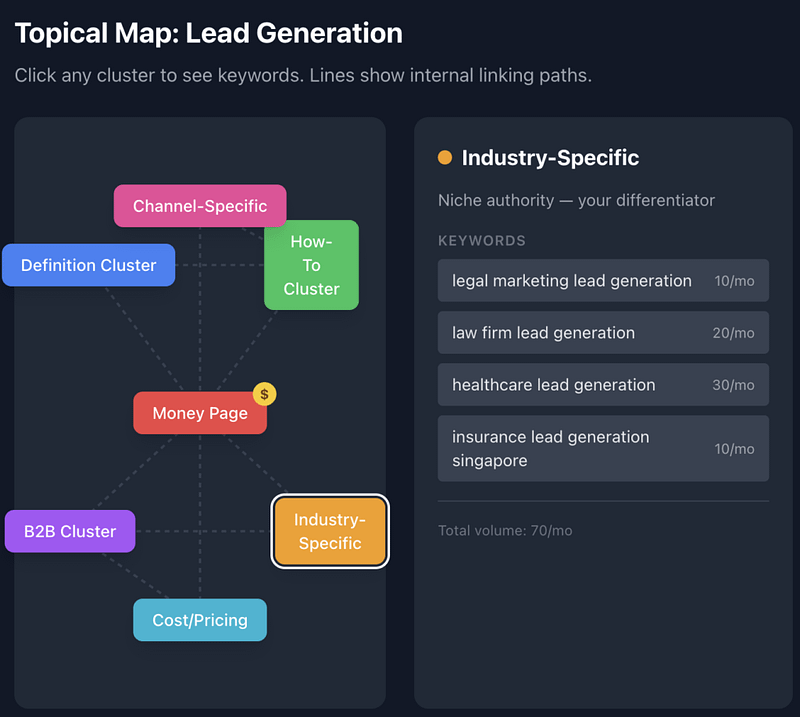
Here’s a rough idea of a topical map for the keyword “lead generation” from Google.com.sg.
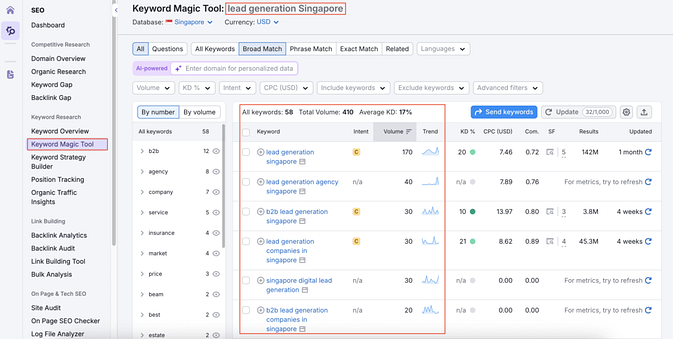
I dumped “lead generation Singapore” into SEMrush’s magic keyword tool, and it generated these keywords. Then I took the keywords, dumped them into Claude, and asked it to sort them into different categories: root pages, recommended clusters, and content nodes in the context of semantic SEO.
Our Sorting:
| Keyword | Volume |
|---|---|
| lead generation singapore | 170 |
| lead generation agency singapore | 40 |
| b2b lead generation singapore | 30 |
| lead generation companies in singapore | 30 |
| singapore digital lead generation | 30 |
| b2b lead generation companies in singapore | 20 |
| sales lead generation singapore | 20 |
| singapore online lead generation | 20 |
| b2b lead generation agency singapore | 10 |
| b2c lead generation singapore | 10 |
| insurance lead generation singapore | 10 |
| lead generation services singapore | 10 |
Claude sorted this as my money page cluster. “Lead Generation Singapore” or “Lead Generation Agency Singapore” should be your root page. Yes, rightfully so.
B2B Lead Generation:
| Keyword | Volume |
|---|---|
| b2b lead generation | 30 |
| b2b lead generation singapore | 30 |
| b2b lead generation companies | 20 |
| b2b lead generation funnel | 20 |
| b2b lead generation strategies | 20 |
| b2b lead generation tips | 20 |
| b2b sales lead generation | 20 |
| b2b lead generation companies in singapore | 20 |
| how to generate b2b leads | 10 |
| how to do b2b lead generation | 10 |
| how to generate leads for b2b business | 10 |
| b2b lead generation agency | 10 |
| b2b lead generation agency singapore | 10 |
| b2b lead generation case studies | 10 |
| b2b lead generation definition | 10 |
| b2b lead generation examples | 10 |
| b2b lead generation ideas | 10 |
| b2b lead generation meaning | 10 |
| b2b lead generation platform | 10 |
| b2b lead generation process | 10 |
| b2b lead generation services | 10 |
| b2b lead generation software | 10 |
| b2b lead generation tools | 10 |
| linkedin b2b lead generation | 10 |
| ppc b2b lead generation | 10 |
| outsourced b2b lead generation | 10 |
Claude told me this is my seed article linking to my money page. It recommended I craft an article targeting “B2B Lead Generation Singapore” since I serve professional services.
Root Page Structure
| Page | Target Keyword | Volume | Absorbs |
|---|---|---|---|
| Lead Generation Singapore | lead generation singapore | 170 | lead generation agency singapore (40), lead generation companies in singapore (30), singapore digital lead generation (30), sales lead generation singapore (20), singapore online lead generation (20), lead generation services singapore (10) |
Content Nodes and Sub Nodes
Nodes: to Link to Root
| Page | Target Keyword | Volume | Absorbs |
|---|---|---|---|
| B2B Lead Generation Singapore | b2b lead generation singapore | 30 | b2b lead generation (30), b2b lead generation companies (20), b2b sales lead generation (20), b2b lead generation companies in singapore (20), b2b lead generation agency (10), b2b lead generation agency singapore (10), b2b lead generation definition (10), b2b lead generation meaning (10), b2b lead generation services (10), outsourced b2b lead generation (10) |
| B2C Lead Generation Singapore | b2c lead generation singapore | 10 | |
| Insurance Lead Generation Singapore | insurance lead generation singapore | 10 |
Sub nodes: to Link to B2B Node
| Page | Target Keyword | Volume | Absorbs |
|---|---|---|---|
| B2B Lead Generation Strategies | b2b lead generation strategies | 20 | b2b lead generation tips (20), b2b lead generation ideas (10) |
| B2B Lead Generation Funnel | b2b lead generation funnel | 20 | |
| B2B Lead Generation Process | b2b lead generation process | 10 | |
| B2B Lead Generation Tools | b2b lead generation tools | 10 | b2b lead generation software (10), b2b lead generation platform (10) |
| B2B Lead Generation Case Studies | b2b lead generation case studies | 10 | b2b lead generation examples (10) |
| How to Generate B2B Leads | how to generate b2b leads | 10 | how to do b2b lead generation (10), how to generate leads for b2b business (10) |
| LinkedIn B2B Lead Generation | linkedin b2b lead generation | 10 | |
| PPC B2B Lead Generation | ppc b2b lead generation | 10 |
Total Pages to Create
| Type | Count | Pages |
|---|---|---|
| Root | 1 | Lead Generation Singapore |
| Nodes | 3 | B2B, B2C, Insurance |
| Sub-nodes | 8 | Strategies, Funnel, Process, Tools, Case Studies, How To, LinkedIn, PPC |
| Total | 12 |
It’s worth noting that one should NOT limit oneself to keyword queries produced by keyword tools. You should also be looking at Google’s autocomplete, People Also Ask, and different vectors of queries around your main keyword.
There are also industry-specific clusters and definition clusters. There’s no need to cover everything in excruciating detail. However, it is recommended to cover all clusters that are relevant to your industry and your end user.
This theoretically fulfils “topical authority” for your “main” topic.
How to Do Semantic SEO: Semantic SEO Practices
The theory goes that Google wants to minimise processing costs. When your site clearly signals expertise in a specific area, Google saves computational resources by trusting you instead of constantly having to reevaluate. You have a cheaper “cost of retrieval”.
To do this, Google also relies on query networks. Semantically connected queries unlock rankings for each other. This means if I were to rank for lead generation keywords first, that may “open up” SEO or Meta advertising keywords since they are semantically related.
How to Publish Content for Topical Authority
For example, if you publish 20 dog feeding articles before your lead generation services page, Google thinks you are a dog feeding site. Changing that classification is “expensive” for Google. They’d rather keep you in the box they already put you in.
To give another example, Google has multiple indices organised by topic and query type. My “legal marketing agency” page puts me in the professional services index. A blog article on “what is breach of contract” may put me in the legal education index.
Intuitively, different indices mean different competitors and different ranking signals. This means, if you start with the wrong content, you end up in the wrong index.
The takeaway: publish your core section, your money pages first. These will establish what your site is actually about. Then, publish your outer section, the supporting content that builds authority and links back to core pages.
In my opinion, this is very similar to traditional SEO methods of reverse siloing. The difference being, you only focus on one “theme” first, probably a theme where you can outcompete your competitors, either via “vastness” or “depth”, ensuring you are ranked on that, before moving on to the next.
Understanding Quality Thresholds, Micro and Macro Context
The theory also relies on macro context and micro context. Micro context is the individual words, phrases, and supporting details in your content. Macro context is the bigger picture, usually the main topic of what your page is about.
To double-check if this is legitimate, I went and did a quick search and found Google’s micro and macro context patent: https://patents.google.com/patent/US7013300B1
Koray also argues that Google doesn’t use keyword difficulty in the way SEO tools present it. Instead, they use quality thresholds. I had to ‘fact check’ this claim and yes… Google’s patents back this up: https://patents.google.com/patent/US9195944B1/en. And here too: https://patents.google.com/patent/US20120166277A1
He argued that Google uses “queries” not “keywords”. It also doesn’t use domain authority or URL rating in the way third party tools calculate them.

Theoretically, Google has a pool of pages it could show for any query. Quality thresholds separate pages that get served to users from those that sit unserved in the index.
The question then is how does Google determine quality?
Theoretically, it takes pieces from your page, understands both micro and macro context, and runs them against a database of websites. It then classifies your page based on these contexts. It is essentially asking: “based on all these macro and micro details, what is this page really about?”
Think of quality threshold as the minimum standard a page must meet to be considered for a query. Relevance thresholds measure how well your content matches searcher intent, and this classification process works along the concept of entity recognition.
Google builds a conceptual understanding of your page by identifying the entities you mention: people, places, concepts, products. It maps the relationships between those entities and compares them to what it already knows from its Knowledge Graph.
Your page is evaluated against Google’s existing model of how these concepts connect.
This is where “information gain” becomes relevant. Google’s patents suggest it evaluates whether your page adds something new to the existing knowledge base of information on a particular topic.
If your page says the same things in the same way as a hundred other pages… then you’re not really providing information gain. However, if you bring original case studies, data points, or a genuinely different angle, you’re adding to Google’s understanding of the topic. This gets rewarded.
Google also doesn’t process every page in its index for every query. This would be too costly given the billions of searches happening daily. Instead, it uses “predictive ranking” to shortlist candidate pages before doing deeper analysis.
So what does this mean for us?
If too many pages fall below quality threshold bars, it drags down your entire website, not just individual pages. Not to fret, this is where an SEO audit comes in handy. You can audit thin content, and the more thin content you clean up, the better you score on quality thresholds.
Initial Ranking vs Reranking and How to Force a Reranking Process
Since Google has a cost of retrieval and the search engine determines the quality of your content by how expensive it is for them to process and rank it. Initial ranking is based on domain trust, content relevance and technical factors. Then Google reranks you based on user behaviour over time: click-through rates, dwell time, and bounce rates.
This is the concept of predictive ranking.
The idea is that Google ranks your website in “states”.
Your site can fall into an upward positive ranking state, or a decreased ranking state. If you’re in a “tier one” site, your site is indexed on the “tier one” servers where it’s prioritised to serve on Google’s search engine results.
Secondly, Google reevaluates when there are significant changes on your site. I find this quite true as published in my SEO case studies.
To “force” a reranking, reduce thin and duplicate pages first. Then publish a bunch of quality articles at once that makes up a considerable percentage of your site. The theory being, this “forces” Google to reevaluate because you’ve changed a significant portion of your site. Google has to reprocess your site because their model of your site is now outdated.
Vastness, Depth and Originality
Vastness means covering many topics at decent quality. Depth means covering fewer topics with exceptional detail. In Singapore, I can’t out publish some of the digital marketing blogs here. Some have more than 1000 “poorly written” articles!
However, I can outcompete them by “out depthing” them.
The next key is originality. In my opinion, Google is getting really good at identifying original content. The opportunity can lie in finding gaps where competitors have thin content in a sub niche.
Take lead generation in Singapore as an example. I am focusing solely on this sub topic first. The hypothesis: how many digital marketing agencies in Singapore actually publish multiple in-depth content pieces on lead generation from different angles, channels, and clusters?
Sentence Structure for Semantic SEO
Koray leans HEAVILY into structured styled content because he hypothesises that it helps Google extract the most important information more easily.

This means starting every section with a direct sentence that clearly states the main point upfront.
The reasoning being that Google doesn’t always read a page from start to finish. It may only process certain parts, break the text into chunks, or pull out key sentences. So by putting essential information at the beginning of each section, you ensure the core message gets processed regardless of how Google reads your content.
One other suggestion is to match answers directly to questions in your content.
For example, if one of your H2s is “How to run faster…”
You should then begin your paragraph by answering the question directly: “To run faster, you should…”. This places the main topic early in sentences. You should also keep facts and opinions in separate paragraphs. This helps both readers and Google to distinguish them.
Note, these are just a some the content structuring principles I took away from my research.
My Own Take on Semantic SEO
Google, as of their recent helpful content updates, recommends against writing for “search engines”. They insist you should be writing for humans. On the other hand, through the years, SEO experts in the community suggest that the weight given to Google’s spokespersons should be taken with a grain of salt.
Yet, it IS mentioned that Google’s BERT is bidirectional. This means your sentence structure does not matter. Google should be able to understand it regardless. Google’s MUM takes it even further by understanding content across multiple languages and formats, including text, images, and video, simultaneously.
Overall, I do not see the necessity of going down the entire list of granular vectors, hows, whys, and whats, and covering all kinds of definitions just for the sake of “hitting” topical authority. I also won’t be obsessing over the granular sentence level optimisations such as the word order in sentences.
I’ll also be testing the concepts of publishing velocity to “force” Google to rerank the tier of our site, and follow the idea of topical maps and a structured manner of publishing.
Hopefully, in time, I can publish the results of this semantic SEO experiment: focusing on one sub topic, competing in depth, originality, and maybe a bit of vastness, being able to rank well for it whilst keeping external factors constant such as backlinks.
