
In the age of semantic search, gone are the days when your content strategy was about publishing a 2000 word article wrapped around a keyword from Ahrefs.
In Google’s API leak, Google is suggested to have moved increasingly towards behavioural signals: click data, Chrome data, NavBoost, brand search volume and site embeddings. These signals are much harder to manufacture than just backlinks or keyword optimized content.
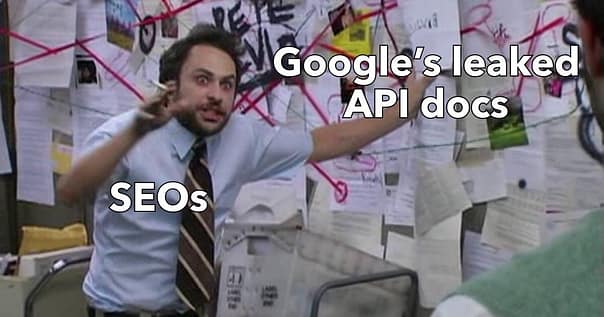
SEO thought leaders like Rand Fishkin also asserted that SEO is a late stage amplifier rather than an early stage growth engine. That SEO no longer reliably build brands from scratch.
“For most small and medium businesses and newer creators/publishers, SEO is likely to show poor returns until you’ve established credibility, navigational demand, and a strong reputation among a sizable audience.”
My years of hunch are confirmed, and this is why I suggest small and medium enterprises go straight into paid online lead generation before considering SEO. Recently, I also spent a couple of months learning about semantic SEO from thought leaders such as Koray Tugberk.
Now, let us not focus on too much doom and gloom. Singapore’s search engine results are not the same as the USA’s or international search results.
Let us also put this semantic SEO strategy to the test locally in Singapore. I shall test out this strategy for this digital marketing agency and my legal tech startup. Then maybe publish a localised Singapore SEO case study or two.
Semantically Related Topics (Not Keywords)
Semantic SEO at its core is about how search engines read, index and retrieve content on the internet. Search has moved away from lexical based, exact keyword matching towards understanding the meaning and context behind a search.
The Google API leak backs this up through its API functions.
anchorMismatchDemotion suggests that Google evaluates the topical relationship between the source page and the destination. It is reading whether the topics are meaningfully related, and factoring that into link scoring.
It is clear that Google no longer ranks pages that contain a phrase. It ranks pages that satisfy an intent.
siteEmbeddings, pageEmbeddings and siteRadius create embeddings for individual pages and your entire site.
Essentially an embedding is a mathematical representation of content expressed as a vector. Similar content produces similar vectors. The distance between two vectors indicates how semantically related they are.
That sitewide vector becomes a fingerprint of the type your site is, topics it covers, the level of quality it maintains and what entities it discusses.
Together they suggest that Google’s evaluation framework, covering links, pages and sites, has shifted towards semantic relationships rather than relying solely on lexical based keyword matching.

Source Context
Today, your site is not merely about a topic. Source context is the angle from which your site covers that topic, shaped by what your site actually is.
Koray directly addresses this in his topical map interview and connects it to the API leak:
“if you are a casino affiliate or directly casino itself or if you are a casino technology provider or whatever you are, your topical map will need to be changing. You will need to reflect your angle. Your source context is important. This is also visible or seen in Google’s latest internal API leak.”
To illustrate, as the owner of a digital marketing agency, I cannot write about lead generation the same way as a product manager at a SaaS platform that helps car companies generate leads.
Your source context determines the angle for every article.
Ultimately, users searching on Google have pain points and are looking for solutions.
The question to ask is how your content is positioned to solve that problem? Can your agency service resolve it? Or is a marketplace solution the better fit? Or would signing up for your SaaS give them access to more solutions?
Today, it is no longer enough to map out your site’s architecture via keywords, remove thin content and publish articles around it. You have to educate users on what makes your way of solving their problem different.
SEO Live Testing for Source Context
For our legal tech startup, the source context will be that we are a marketplace powered by software that educates and matches consumers to legal practitioners. This way we do not get classified in the content site category or competing directly against legal services.

Originality of Content
OriginalContentScore and effortScore support the quality side of the argument. Google has confirmed signals that estimate content quality and creation effort.
Strategy 2: Covering Attributes, Entities and Not Just Topics
In the old ways of SEO, an approach to targeting the query “lead generation” looks like this. You form a cluster and publish content around keywords related to “lead generation.”
Article 1: What is online lead generation
Article 2: Best lead generation tools
Article 3: How to generate leads online
Today, a semantically relevant topical map approach can be broken down into topics, entities and attributes:
- Channel Specific: Traffic Sources
- How to’s Information: How to Set Up Nurturing Sequences
- Specifics to Industry: Dental, Healthcare, Blue Collar
- Metrics: Conversion metrics, cost per lead by channel and industry
- Tools: Lead Generation CRM integration etc.
Example of a Visual Topical Map Generated Based on Queries:
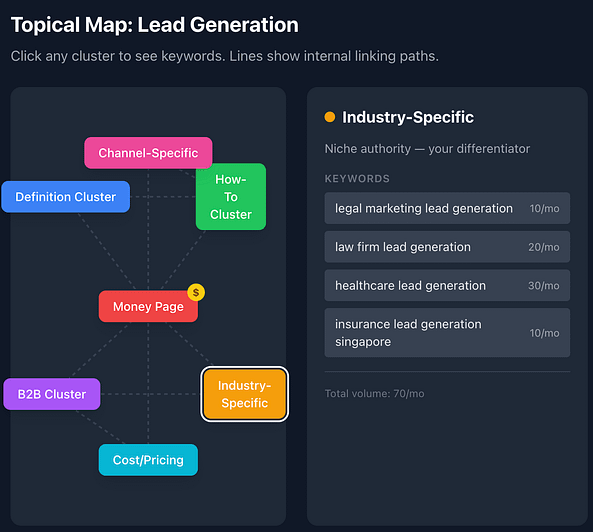
Just publishing bland content around a main keyword is not enough.
When you write a dedicated page about “lead generation for dental clinics,” you are creating a document where that entity dominates the entire semantic structure. Google can identify it clearly, classify it, and connect it to your site’s established topical fingerprint.
Write a generic “healthcare marketing strategies” article that touches on lead generation for dental clinics alongside nine other attributes without depth, and no single entity dominates. Google cannot clearly determine what the page is primarily about.
The better approach is to map out the full attribute coverage of “lead generation for dental clinics” and build a dedicated page around each one.
- Google Ads for dental clinics
- Facebook and Instagram Ads for dental clinics
- Local SEO for dental clinics
- Measurement and ROI: Cost per new patient
- Patient journey mapping: Patient retention and recall marketing
- MOH advertising guidelines
How to Find Queries and Attributes
Today, while I still use Semrush extensively for query research, I am starting to take traditional SEO metrics with a pinch of salt. Koray has deprecated his weightage or even the use of traditional SEO metrics such as domain authority or URL rating.
Note that I mentioned the word “query” and not keywords.
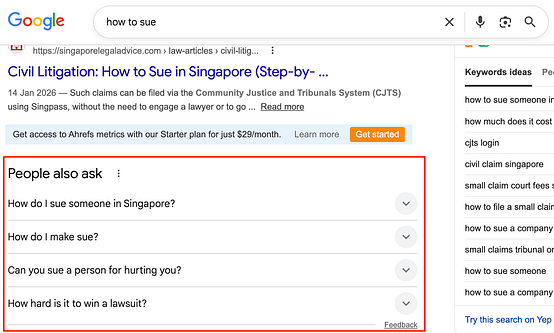
You can also look at People Also Ask Google results or get a paid tool such as Answer the Public.
How are Sites Clustered and How it Affects Your Strategy
PerDocData references the hostAge attribute, which is used to sandbox fresh content during serving time. New content does not enter the index on equal footing. It is evaluated against the host domain’s credibility and established history before Google serves it at full visibility.
sourceType: 1 from Google’s API also suggests that the source sits in a primary index and is associated with high quality, original content.
These functions suggests that Google creates a fingerprint of your entire site based on the aggregate topics you cover, the depth and consistency of your content, quality patterns, and the entities and attributes you discuss.
New pages are evaluated against this fingerprint before Google has accumulated enough independent data to judge them on their own merit.
Clustering: Measured Against Similar Sites, Not the Entire Web
The API leak confirms signals like siteEmbeddings and siteFocusScore that suggest Google groups sites before ranking them. Koray builds on this.
“If your website type is in the losing cluster, it doesn’t mean anything after that point how many referring domains you have or how many users or what type of CTR you have. If you are in the losing cluster, you will keep losing.”
– Koray Tugberk
To add on:
“Several modules point to Google potentially using different ranking systems, factors, or adjustments for specific verticals like:
Travel (“GoogleApi.ContentWarehouse.V1.Model.QualityTravelSitesData”)
News (“GoogleApi.ContentWarehouse.V1.Model.NewsPublisherScores”)
Video (“GoogleApi.ContentWarehouse.V1.Model.VideoContentSearchScoringSignals”)
Shopping/E-commerce (“GoogleApi.ContentWarehouse.V1.Model.ShoppingAnnotations”)”– Rebekah May
They suggest that your rankings are determined by how you compare to sites in your cluster and not the entire internet.
Clustering and Topical Relevance in Your Content Strategy
This means that as a content strategy, do not publish random articles. Your articles have to create logical paths. Each topic leads to the next within an confined expertise area.
That is how topical authority compounds over time. They signal to Google that your content exists within a logical, expertise driven structure rather than a collection of unrelated pages. This is commonly found when SEOs chase separate keywords.
For our digital marketing agency site, online lead generation is positioned as a core topic. From there, it branches into two industry verticals.
The first branch is legal marketing services. Topically, there is: SEO for law firms, Google Ads strategy for law firms, Facebook Marketing for law firms and the Legal Profession Act regulations.
The second branch is healthcare marketing services. Topically there is: SEO for doctors, SEO for dentists, patient acquisition channels, appointment conversion optimisation, patient retention, recall marketing and MOH advertising compliance.
Practical Implications of Clusterisation
An E-Commerce site versus a content site versus a SaaS tool puts you in different clusters with different competitive dynamics.
Koray repeatedly suggests adding functionality to your site. E-commerce elements, free tools can signal to Google differently and shift your site into a more favourable cluster.
“if there are 500 sites that link to an e-commerce site the search engine will rank e-commerce site directly they will just try to remove the middleman because no one searches for the middleman anymore”
– Koray Tugberk
Today, a pure content site where visitors can only read and leave has no functional identity beyond its text. By adding something for users to do, submit, purchase, or log into changes the type of site Google categorises it as.
The content site is the middleman. It sits between the user and the actual solution. Users want to land on the site that fulfils the intent directly.
This is a plausible explanation for why many affiliate and review sites were crushed simultaneously in recent helpful content updates. It was not about individual site quality. It was a categorisation level decision.

Topical Deviation and Focus
Koray has also suggested publishing content in accordance with your source context.
“your site should have a main focus and you should reflect it on every page on your website.”
“once you have chosen your source context you have to choose a central entity. The central entity should be appearing sitewide.”
– Koray Tugberk
siteFocusScore is mentioned in the leaked API as a confirmed attribute. It is described as a score of how focused a site is on particular topics.
In short, do not deviate from topics until you have established topical authority in a certain topical cluster. For example, I should not be publishing content about social media influencer marketing or E-Commerce branding.
It signal a clear deviation from my topical cluster as a legal and healthcare digital marketing agency.
Conclusion
The API leak only confirms many hunches that leading SEO practitioners already had. Today, producing SEO content that answers long tail queries such as “how to sue in Singapore” is no longer as simple as wrapping factual content around the query.
You have to take into account your source context, and how it relates topically across other pages and your overall site.
Yet it has given original creators hope.
The system is not just gameable with backlinks anymore. Original content and human effort are allegedly ranking factors. If you put in genuine, original effort into your content, you are in a better position to reap the rewards.
